
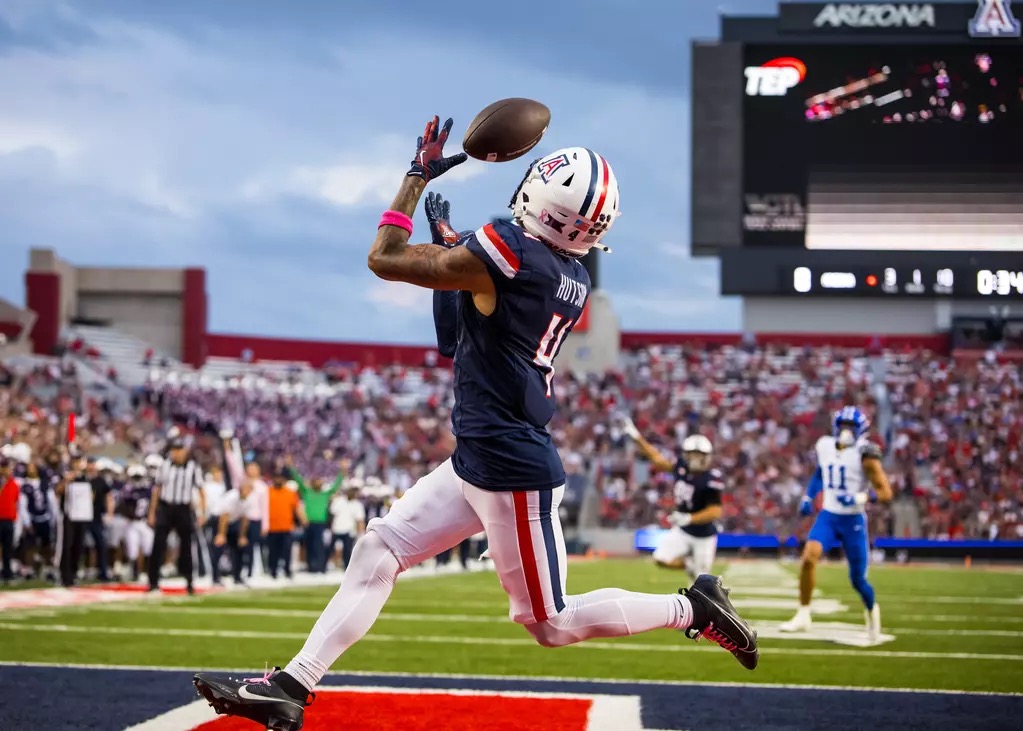
Arizona lost arguably the most devastating game of the Brent Brennan era, falling to No. 18 BYU 33-27 in double-overtime after holding a 24-14 lead midway through the fourth quarter. The Wildcats executed the game plan fairly well, but questionable play-calling and a lack of efficiency in the red zone ultimately cost them the game. Here are our five reactions and takeaways from the Arizona Wildcats’ double-overtime loss to the No. 18 BYU Cougars.
1) Red zone was ice cold, not red hot
In the official the boxscore, the Wildcats scored on 2-3 red zone trips in the loss to the Cougars. But that doesn’t quite tell the whole story. The one miss in the boxscore came midway through the third quarter, after Arizona put together a 14-play, 71-yard drive that chewed up nearly eight minutes of clock, but resulted in no points after the Wildcats could not convert on fourth and four at the BYU five yard line. That decision not only cost the Wildcats three points, which could have likely been the difference at the end of the game, but also opened the door for a change in momentum that BYU capitalized on throughout the fourth quarter.
The red zone struggles continued in overtime for the Wildcats. Arizona rode running back Kedrick Reescano to start the extra period with three-straight runs, including a nine-yard touchdown that was wiped off the board by a holding call on left guard Chubba Maae. The Wildcats came out clawing and scratching in overtime, but costly mistakes kept the door open for BYU.
In the second overtime period, Arizona’s offense sputtered, needing a fourth down conversion by Quincy Craig at the BYU 16 yard line, before gaining just four yards on three plays, setting up a fourth and six at the BYU that ultimately closed the door on an upset victory for the Wildcats.
It’s not just that the Wildcats couldn’t move the ball or convert in the red area when it matter most, it was the play-calling and design down low. Arizona never seemed to have a good sense of where the line to gain was, throwing short of the sticks, and opted to keep the ball in Arizona’s hands after while running back Kedrick Reescano and Quincy Craig were averaging 6-plus yards per carry throughout the game.
Arizona has plenty of weapons on offense, between its three-headed monster at running back, and the stable of receivers, including Tre Spivey, who emerged as a red zone threat against Oklahoma State. Unfortunately, Spivey was only targeted twice in the game, as the Wildcats could not take advantage on their trips down the field.
2) Play-calling and decision was…something
While Arizona’s play-calling has been mostly effective this season, Brent Brennan and Seth Doege dialed up some questionable decisions that ultimately cost the Wildcats the game. The first is the decision to go for it on fourth down in the third quarter after the lengthy drive. While the failed conversion did pin BYU deep in its own territory, had the game held the way it did the rest of the way, those three points would have been the difference between an upset over the number 18 team in the country, and double-overtime loss.
The second eyebrow-raising decision came at the end of regulation. After BYU scored to tie the game at 24 apiece, Arizona got the ball back at its own 24 yard line with 19 seconds and two timeouts remaining, but elected to take a knee and send the game to overtime. 30-40 yards would have put Michael Salgado-Medina in field goal range. Who knows if Arizona could have picked it up, but with the the time left and two timeouts, why not take a shot?
Brent Brennan wasn’t playing to win, he was playing not to lose, and not keeping his foot on the gas ultimately cost the Wildcats an upset win and 5-1 start to the season.
3) Wildcats run out of the building
Arizona allowed a season-high 258 rushing yards to No. 18 BYU, more than twice as many yards as the next-highest opponent (Weber State, 116 yards). On Thursday, Brent Brennan called BYU’s LJ Martin the best running back Arizona has faced through six weeks, but the Wildcats still had no answers for the physical runner. The bell cow carried the ball for a season-high 162 yards, and averaged 6.5 yards per carry.
A player like Martin is always going to get his, but Arizona had no answers for him on Saturday, and was unable to do much of anything to limit his production.
On top of that, the Wildcats knew coming into the week that true freshman quarterback Bear Bachmeier has been an effective runner this season, yet they allowed him to pick up 89 yards and two touchdowns, including the game-tying score at the end of regulation, and what would wind up as the game-winning touchdown in the second overtime period.
Arizona has boasted one of the nation’s top defenses this season, but against BYU, the Wildcats looked overwhelmed and under-prepared against the Cougars’ bread and butter on offense.
4) Cat Call: Kedrick Reescano and Kris Hutson
Two bright spots for Arizona were running back Kedrick Reescano and wide receiver Kris Hutson. Both players have been banged up this season, but showed Arizona fans how lethal they can be when fully healthy. Reescano carried the ball 13 times for 90 yards and a score, averaging 6.9 yards per rush. His decisive, downhill running was lethal against BYU, and compliments Ismail Mahdi’s more elusive style, as well as the pass catching ability of Quincy Craig.
Kris Hutson played his best game as an Arizona Wildcat on Saturday. After getting banged up in training camp, Hutson flashed as Noah Fifita’s favorite target against BYU, hauling nine receptions for 106 yards and a touchdown, all season-high marks. Hutson is an decisive route runner who can make plays at all three levels of the field, and can use his speed and elusiveness to make defenders miss once the ball is in his hands.
If Arizona can continue feeding Reescano and Hutson, while getting Ismail Mahdi, Tre Spivey, and other offensive play makers back into the fold next week, the Wildcats should be able to get back on track against Houston.
5) Cats clawed backed after 14-0 start and weather delay
Arizona was unable to upset the nation’s 18th-ranked team, but did showed some impressive fight and poise, particularly in the first half. The Wildcats fell behind early, trailing the Cougars 14-0 after allowing their first passing touchdown of the season, but responded with a solid eight-play, 75-yard scoring drive to end the first quarter, cutting the lead in half. Then, the 75-minute weather delay hit, stalling the momentum Arizona was starting to build. But the Wildcats didn’t let it derail them, outscoring BYU 10-0 in the second quarter to take a 17-14 lead into the locker room at halftime.
Why is this important? Because a season ago, the combination of that start by BYU and the weather delay would have been catastrophic for Arizona. While the Wildcats still have a lot of work to do, they are clearly much improved on both sides of the ball compared to a year ago. Overall, they are showing a different level of poise and maturity, understanding of the scheme, and ability to execute that scheme, helping them stay competitive even in a tough loss like Saturday’s.